

Calling Customer Service? What It’s Like on the Other End
The customer service industry struggles to retain workers and figure out AI

When you speak with someone from customer service, do you ever think about their day? Of course not. You don’t care! You’re probably frustrated, though maybe not this frustrated. Warning: language.
Last month I was forced to care about the person on the other end of that phone call.
For the third year in a row, I moderated panels at Customer Contact Week in Las Vegas, the largest gathering in the customer service industry.
This year, a record 5,500 people attended. Shaq was the keynote speaker. I was there as they searched for a chair big enough to accommodate him (though in this Instragram video, it looks like he didn’t sit much).
According to research collected by Zoom, there are nearly three million call center workers just in the U.S.
If accurate, that’s nearly 1% of the population. That doesn’t even count the international agents working for American companies.
This is an industry where turnover is high, so there’s a lot of outsourcing. But employees working in the Philippines or Honduras or East Africa often need extra training due to cultural and language challenges for American companies. For example, one manager told me he had to explain what a Costco is to staff on the other side of the world — “You can buy everything from golf clubs to furniture to cheese to clothing to dishes to… “
And everyone at the Vegas show was trying to figure out how artificial intelligence can cut costs while also improving customer experience, aka “CX.”

I’ve covered a lot of conventions in this town, but Customer Contact Week always stands out for the energy in the room. It takes a unique type of person to go into customer service, and I’ve never encountered so many strangers initiating conversations with me — “Hi (looks at name tag), Jane! How’s your day going? How are you liking the conference?”
They were eager to learn.
“Accent Conversion”
Vendor after vendor at the convention leaned heavily into selling new artificial intelligence functions. My favorite was “accent conversion,” which transforms the accented voice of an international agent into someone who sounds like you! Here’s video from a company called Krisp converting a Filipino accent into British English.
Wild!
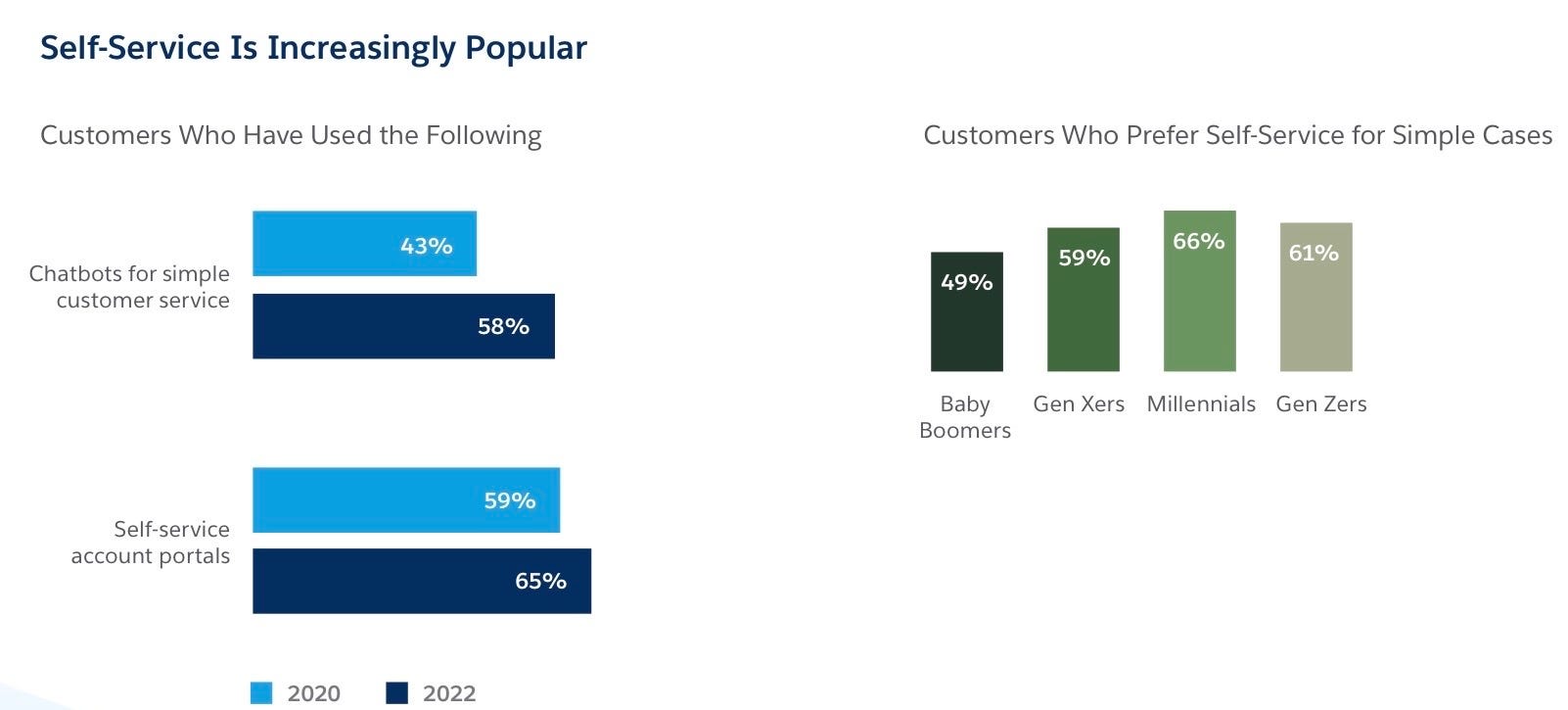
Data provided by J.D. Power suggests most customers still prefer the human touch, though they’re not averse to new technology. For example, Salesforce released a chart showing how quickly people embraced chatbots during Covid.
Some in CX fear there’s too much reliance on AI. One head of customer service coined the phrase “capacity illusion.” That happens when companies spend a ton of money on AI, yet it only prolongs customers’ agony.
Take me, for example. I like AI. I don’t want to talk to an human. I prefer to solve issues through a company’s website or app. But when I can’t solve a problem, I need a human. Too often, however, I’m put through a long AI chatbot conversation that goes through every potential solution I JUST TRIED, before the bot finally connects me to a person.
In this case, artificial intelligence isn’t helping, it’s just being really annoying.
I told this to the head of customer service at a large international delivery company. “Ah, yes,” he replied. “People just start typing, ‘AGENT! AGENT! AGENT!’”
The technology is making some things better, though.
For one thing, when’s the last time you hung around after a customer service call to answer “a few questions” about your satisfaction? Yeah, me neither. And whenever I see an email with the subject line “We’d like your feedback,” I hit “delete.”
The head of a large international automaker told me these surveys are “completely useless” because so few people answer them. He discovered that only 16% of customers filled out satisfaction surveys, and the company had no idea how the other 84% felt. His firm began using AI to listen in on 100% of customer calls to analyze pressure points and satisfaction. The feedback was a lot more effective than surveys. More companies are using AI this way. Just know that a bot is listening when you are on the line. “This call may be recorded…”
Quick Solutions are Not Necessarily Best
Companies have always prized how quickly an agent solves a problem and moves on to the next customer. It’s called “Average Handle Time,” or AHT.
But often a short AHT does more harm than good. If you’re dealt with quickly as a customer, you’re more likely to call back quickly when the “quick fix” doesn’t work. This actually increases resolution time (and frustration).
Customer service managers I met with — who often started out answering calls — are encouraging top brass to stop relying so heavily on AHT and consider other metrics, like how many customers don’t call back. Taking a little more time on the phone with a customer to reverse engineer a problem may actually resolve the issue for good. What’s more, it may unintentionally “train” the customer to stay loyal, because the agent cared and didn’t rush them off. It’s possible that longer phone calls lead to fewer repeat calls and happier, more loyal customers. Who knew?
“My Customers are My Employees”
The biggest issue remains retention. Keeping agents on the job is no small feat. “My customers are my employees,” one manager told me.
Obviously, higher pay would help, but that’s not always profitable. It often comes down to a more engaged manager.
Look, this is a stressful job, and it’s easy to quit, especially since many agents work remotely. As AI takes a greater role solving easy problems, human agents are left with only difficult ones. Some agents like that challenge, others don’t. Being alone on the phone with unhappy customers all day can feel very isolating.
Having a place to vent helps. There’s an Instagram account just for CX agents called @csrdiaries.
What’s also keeping employees from quitting? Things like providing career paths, “virtual” call center floors where managers can hop in if there’s a tough customer, or competitions among employees for monetary prizes.
I heard some unusual ideas.
One head of CX for a national retailer lets his employees set their own schedules. “Really?” I asked. “Who volunteers to work the graveyard shift?” He told me they don’t have a lot of employees working overnight, but they also don’t get a lot of calls overnight. Plus, they now have a call center in the Philippines. Nighttime here is daytime there.
This same executive also lets his employees spend a portion of their time pursuing pet projects for the company, and sometimes it pays off. Two of his CX employees started posting videos online about their top customer service complaints, showing how to solve the most common problems. The videos were a hit, and the manager says he noticed a drop in calls.
What Practices Should Die?
My favorite panel was one that dealt with programs and policies and initiatives that never die, even though they’re not helping! This is so true in any industry. I remember when CNBC was owned by GE, and my parent company was forcing the Six Sigma efficiency program on the newsroom in order to improve productivity. But journalism isn’t like manufacturing refrigerators, yet no one had the courage to tell legendary CEO Jack Welch, “This makes no sense in our operation.”
Customer service is no different.
On my panel, the guy who runs CX at the international automaker told me that when he got the job, he discovered that customers had to go through six steps of identity verification. Six. “More than banks require,” he said. So he diplomatically asked his team, “Help me understand why we have this. Who came up with it?” No one could answer. He eventually cut the verification steps from six to three. That’s still too many, he admits.
Then there’s the woman who runs CX at a financial firm. When she joined the company, she asked all of her supervisors to send her their regular written reports. She held onto the reports and didn’t send them out. She waited for someone to ask, “Where’s that report?”
If no one asked, she killed it.
That’s a good strategy for every company, regardless of industry.
Meantime…
One random note about Vegas.

For Love and Money
When I landed in Sin City, it was 109 degrees, which never seems to stop people from coming. Tourism numbers released by the Convention and Visitors Authority show total visitors in May were up 2% from a year ago, helped by BTS concerts and the Golden Knights making it to the Stanley Cup. However, airport arrivals were down, not just for May but for the first five months of the year. It’s getting expensive to fly.
So perhaps I shouldn’t have been surprised when my cabbie from the airport complained about business. (I take a taxi in Vegas rather than Uber because it’s faster and cheaper.) The driver told me he was born in Eritrea, in East Africa, “but I’m an American now.” When I asked him whether Las Vegas is busy these days, his mood soured. “I miss the Canadians, they don’t come.” They are “very generous” with tips. Gee, I wonder why Canadians have stopped coming to America? Hmmm…
My driver then told me he wished he had more money, because money is everything. EVERYTHING. “It can even buy love,” he said.
“Really?” I replied. “Yes,” he said, firmly.
I told him I disagreed.
He looked at me in the rearview mirror. “That’s because you have money.”
Fair.
💰💖💰💖💰💖
Still just the biggest fan of your storytelling. Thanks so much, Jane. I enjoyed learning this...
Who knew there was such a convention? I never figured Call Center people got together to discuss their business because to me the business never seems to change!
This was a very informative article, Jane. Thanks for taking the time to write it. However, (you might've anticipated there would be a "however") you didn't mention the one thing that really bugs me the most about customer support. Especially those that answer my call with a foreign accent. I don't mind that the person is talking to me from another country. What bugs the hell out of me, though, is the annoyingly predictable script they all regurgitate.
After you state your issue, they invariably come back and repeat the issue to you. "I understand, Miss Diane, that you want to know why we charged you for your purchase twice." Yeah, that's what I just said! Why is this person repeating it to me? BECAUSE THEY ARE READING FROM A MANDATORY SCRIPT!
This annoying type of dialogue continues throughout the call. I may be contacting the company because I did not get the item I ordered,although I have received an email telling me it has been delivered. I relay this to the customer service agent and, predictably, they respond with, "I understand you did not receive the delivery. Is that correct?" yeah, that's what I just said!!
"Hello," I might say. "I need to return an item I just received because it doesn't fit right. How do I get a return label?" And don't you know it - the customer service agent responds by saying, "I hear you say that you ordered some thing that doesn't fit you and you need to return it but you don't have a return label. Is that correct?" My response is something like, "Grrrrrrrrrrr. Yes, THAT IS WHAT I JUST SAID!!!"
All of this and unnecessary banter only serves to prolong the agony for the customer when they contact a service agent. So why do they keep insisting on these insipid scripts?
I'm wondering if this topic came up at the convention-- and if so, Jane, I would love to hear the company answer as to why they think it's a good idea.
We always look forward to your next post!